Thursday, 12 May 2011

Tuesday 10th May 2011 - Mystras, Greece


Castle view has a washing machine so Jane took the opportunity to catch up on the washing. After a short walk into the village of Mistras, we spent the rest of the day relaxing and reading.
Photos: A statue of Constantine, despot of Mystras from 1443 to 1449 and the last Emperor of Constantinople – a fierce, determined man who you wouldn't want to upset!

Monday 9th May 2011 – Mystras, Greece


We set off this morning to spend a few days in Corinth and ended up in Sparta! And this is how it happened.
We have been to Corinth a number of times but have never visited Acrocorinth set high on a hill south of the famous ancient Corinth. All went well as we crossed the Corinth Canal, stopping for the mandatory viewing. On other trips we considered ourselves lucky if we saw a single ship using the canal but this time there was a trip boat, a tanker and a number of private yachts. As we approached Corinth my Sitnav (Jane) was map reading and informed me that we should be able to approach Acrocorinth from either the Tripoli road or the Patras road. So we followed signs to Tripoli as there were no signs to Ancient Corinth or Acrocorinth and found ourselves on the motorway. This wasn't a problem as the map showed a junction close to Acrocorinth but when we got there, we found that you could leave or join the motorway if you were heading north and you could join the motorway heading south. However heading south as we were, there was no way to leave the motorway. Sitnav informed me that it was “absolutely miles” to the next junction and, as we suspected, we soon came to a toll station. £5 worse off and we were still heading in the wrong direction with no easy way of returning except by leaving at the next junction, rejoining the motorway and paying another £5 going back. This did not appeal and therefore, not for the first time, we adapted the itinerary. We knew that we could visit Corinth later in the trip so we headed for our next intended stop near Sparta.
At some point we knew that we would need to fill up our LPG tank and from the very helpful and interesting MagBaz site (www.magbaztravels.com) we knew that the only LPG supplier in the Peloponnese was based in Tripoli. So after paying another £5 in tolls we got to Tripoli and following the excellent directions provided to MagBaz by Andy, we arrived at the garage and filled up. We only needed 11 litres (approx. half the tank) after 4 weeks of travelling so we will certainly have plenty to see us through the rest of the trip.
On the way to Sparta from Tripoli I spotted a sign to the Sanctuary of Elea Athena. Helpfully, and most unusually, the sign told us the distance, only 1 km, so I followed it. Almost all Greek sites and museums are closed on Mondays but we were pleasantly surprised to find the gate unlocked and n attendant in the office. He waved us through and told us that it was free and it proved to be very interesting. There was a temple here in the 7th century BC (and evidence of two earlier ones) but that was burnt down in 395 BC and a new temple built to replace it. It was one of the most famous temples in Greece and it was here at the fountain (still visible) that legend has it that Heracles met the nymph Auge. She gave birth to Telephus (surely the god of telecommunications – if not, why not?) here at Tegea. Further remains of Tegea are just 2 minutes down the road at Palaia Episkopi. Although the remains are scant, the village is well worth a visit with its large church overlaying part of the ancient theatre and a lovely shaded park with benches. There is also a good taverna here but we chose to have a picnic in the shade. The folk museum based in the park is supposed to be very good but it is only open at weekends at this time of the year.
Making our way without any problems through Sparta, we headed for our campsite Castle View at Mystras where we parked in the shade of two olive trees.
Photos: Glaros campsite at Kineta – the beach bathed in morning sunshine; A tanker is pulled through the Corinth Canal; Statue to the Tegean Mother in the park at Palaia Episkopi.

Sunday 8th May 2011 - Kineta, Greece


When we checked the Kineta train station yesterday we found that the suburban train station was closed and the line had obviously not been used for some time. However we discovered that the new train line also had a train station at Kineta, slightly outside the village and closer to the campsite. We went to check the times of trains and discovered that the ticket office was closed. A sign, luckily in English as well as Greek, reminded us that we had to have a ticket before we got on the train but stated that we would have to go to another station to buy a ticket. The campsite owner was unaware of this and made a couple of phone calls where, judging by his tone of voice, he was saying something like “how are visitors expected to used the station if they have to travel to another station to buy the tickets?”. He came off the phone stating that it was mad and down to 'the crisis' i.e. the dire state of the Greek economy and the cuts that have been made to attempt to correct it. He kindly offered to buy some tickets for us and also bought more for future use by his customers. So we drove to the 3km to the station, parked up, validated our tickets by stamping them (dire warnings about not doing this too) and waited on the platform. A notice said that the electricity was switched on for the railway at the end of October 2010, so everything was new. However, the electronic train information boards were not working, the simply said, only in English, 'Pay attention to the announcements' and there weren't any! The clock on that board was stopped at 12:00 and the two other clocks on the platform read 08:00 and 08:03 when the time was actually 09:06. The train couldn't have been in service for more than seven months and yet it was covered in very poor standard graffiti – all over the metal and half way up the windows. The train arrived and left early so it was bad luck if you arrived just before the appointed time. It is very sad that even with a prestige project like this new railway line, the Greeks can't get it right.
We arrived at Athens Central Railway Station less than one hour later and decided to walk to the Archaeological Museum. We were in luck as it was the one day in the month that it was free but staff shortages ('the crisis' again) meant that many rooms were closed. However the room housing the finds from Santorini, the thing that we most wanted to see, was open and we went there first. I won't bore you with the details but even with the restricted access, there was plenty to see with some wonderful finds from all over Greece.
When we came out three hours later we watched thousands of cyclists making their way into the centre of Athens. We never found out whether it was a protest or a celebration but it was peaceful and everyone, including many families, seemed to be having a good time. We walked on to Syntagma Square and caught the changing of the guard by the tomb of the unknown soldier outside the parliament building. The Greek soldiers dressed in their traditional white outfits with a mini skirt, tights and pom-pommed clogs, performed their amazing, slow-motion and complex choreographed routine. Each time that we see it we admire the precision and timing but we can't believe quite how silly it looks.
On then for an excellent meal at 'O Platanos' on Diogenous Street on the edge of the Plaka. This taverna was established in 1932 and its food and position in a small square by the Temple of the Winds makes it very popular with the Athenians.
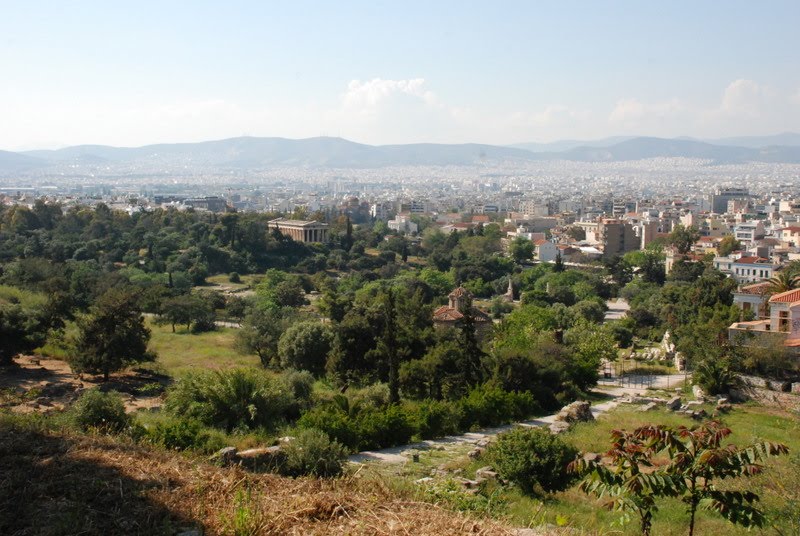
We then spent an hour or so wandering around the slopes of the Acropolis Hill enjoying the architecture and views across the city. We stumbled across a small monastery in amongst the houses and I asked whether there were still monks there. It was still a monastery but only had occasional visits from the monks as they were based in Jerusalem!
We took the underground train from Akropolis to Larissa (Athens Central) where we caught our train back. Just as we approached Kineta we passed a company selling prefabricated chapels with lots of models on display. That surely could only happen in Greece!
Photos: The head of a monumental bronze statue of Zeus (or possibly Poseidon) from 460 BC – Athens Museum; The changing of the guard in Syntagma Square; View of the Agora from the Areopagus hill next to the Acropolis.

Tuesday, 10 May 2011

Saturday 7th May 2011 – Kineta, Greece


We had a good start this morning anticipating a long period hunting for Eleusis. It was the first time that we had approached Elefsina from this direction and shortly after passing under the motorway and heading toward the town centre we were rewarded by our first sign to Eleusis. This was followed by more signs and we were soon parked outside the site. It was remarkably easy and we wondered why we had so much trouble before. Part of the issue was that the guidebooks often describe the site as being surrounded by oil refineries and cement factories. It is true that the view from the site is horrible and includes these but it is actually within the town and we had always envisaged it as being well outside.
Eleusis was a very important cult centre, occupied from at least as early as the 15th century BC and initially a rival to Athens before coming under Athenian rule in the early 6th century BC. The Sacred Way lead from Athens to Eleusis, a distance of 19km (12 miles), and during the nine-day festival of Greater Eleusinia a procession came from Athens to the Sanctuary of Demeter at Eleusis. Only those initiated into the Eleusian Mysteries were allowed to take part in the procession and to witness the rituals that took place in the sanctuary. The number of initiates obviously grew over the centuries as the sanctuary was rebuilt and enlarged many times including one extension that involved building over ancient walls many metres high. The Mysteries were secret and the penalty for revealing them was death and this might explain why we still don't know much about them. However Demeter was connected with the seasons, fertility and crops and it is probable that these themes were prominent in the ceremonies.
The Mysteries were celebrated well into the Roman period and at least three Roman Emperors are known to have been initiates. Indeed the Romans remodelled and enlarged much of the site adding many fountains and baths. It is largely the Roman remains that are visible today although more ancient walls and features are also visible.
We spent three hours walking around the site, reading the information plaques, looking at the remains and trying to imagine what the initiates observed during the ceremonies. It is suggested that after fasting, they ate fermented cereals that may have an effect similar to LSD, so they may have seen some very interesting sights!
Travelling West along the old national road we arrived at Kineta and Glaros Camping where we took a pitch close to the sea.
Photos: The sacred area on the sanctuary at Eleusis – the stone seats at the back are for the initiates to watch the Mysteries; Part of a 5th century BC white plate from Eleusis; A Roman votive piglet from Eleusis.

Friday 6th May 2011 – Inoi, Greece


Our aim today was to get off Evia and to Thebes in time to visit the museum there. However a combination of mountains, windy roads and slow lorries (even slower than us!) meant that we weren't going to get to Thebes museum before the likely closing time of 15:00. There are no campsites anywhere near Thebes so we decided that we might be able to find a restaurant on the outskirts that would allow us to stay overnight in their car park if we had a meal there. We have used this option on a number of occasions and it works well. However, at Jane's suggestion, we decided to go to the museum first to ensure that it was actually open. Our Blue Guide published, we think, in 2007 said that the museum had been undergoing restoration but was reported as having been reopened. Well, it hasn't and shows no signs of being opened in the near future. The Blue Guide describes Thebes as being “as undistinguished today as it was glorious in antiquity” and we have to agree. Fortunately the museum, although closed, was well signposted and we found it quite easily. Getting out of the city was slightly more difficult, involving many rather narrow one-way streets but we managed it and took the old national road towards Elefsina. We intended to visit Eleusis tomorrow if we could find it – this would be our third attempt. There are no campsites in this area either so we decided to find a place to wild camp somewhere off the national road.
After passing the very impressive tall walls of the 4th century BC fortress of Eleutherai we turned off the main road and ended up on the outskirts of the small village of Inoi. We found an excellent, flat area off the road near to the church of Agia Triada. We went off to investigate the village and found that the centre was based around the main road and we bought some wholemeal bread (called Mavro – black in Greek), sweet bread and baklava from a very good baker who also spoke English. Across the road there was a shop selling the local wine straight from the barrel. After trying the different wines, we bought two 1.5 litre bottles one of white and one rosé both of which were not resinated.
Photos: Wild camping pitch in Inoi; In Inoi the bakers start very young; Jane at the Inoi wine cellar just before I was about to lie under a barrel and open the tap – unfortunately the proprietor arrived before I could do so!

Thursday 5th May 2011 – Rovies, Evia, Greece


Lots of rain during the night and lots of rain this morning meant that doing the chores was a very damp process especially as the waste water, fresh water and chemical toilet facilities were a little walk away. Although the campsite is very sophisticated, with a very swish swirling water swimming pool, the toilet block that was open only had foot toilets (slightly sophisticated holes in the ground). This did not go down well with Jane! Having said that, the price was very reasonable at €14, the cheapest so far in Greece.
The prospect for the first part of our drive did not look good. It was still raining, if only gently, and low cloud hung over the hills. Soon we were up in the fog of that cloud and although the forest was pretty, there was no chance that we were going to see any views. As we drove along we started seeing plastic bags attached to the trees. At first I thought that it was some type of bug trap and then I realised – they were collecting sap. Pine resin is added to wine to produce Greek Retsina, the famous, some would say infamous, Greek wine. We really like it but the resin flavour does take some time to get used to and some people never get used to it! It may seem a strange thing to do but it stems back to the time when wine was transported in animal skins that were sealed with pine resin. This imparted a flavour to the wine, the Greeks got used to it and continue to add the resin well after the skins were replaced by bottles.
As we rounded the north east of the island, we descended from the mountains and were finally able to see the sea even if it was still raining. We stopped at Orei to find the 4th century BC marble bull that was on display of the seafront. We found it and it was very impressive. We also found the Ouzeri (bars specialising in selling the Greek aniseed drink Ouzo) that Orei is well known for. I chose the one that had no name, looked basic and had lots of local customers including a Greek Orthodox priest. It is a tradition that ouzo, especially in an Ouzeri, is served with 'mezethes', little pieces of food. It is a tradition that is fast disappearing but in some places you are served something simple like little pieces of tomato and cucumber. It used to be common to be served a little cheese and / or olives but these have become relatively expensive and so it is rare to get them. Here our ouzo arrived together with some bread and we thought that was the mezethes but a few minutes later came a dish with six small fish, horta (wild greens) and two pieces of lemon. The fish had been chargrilled and the horta was cold and both were delicious. When we came to pay the bill it was €4, the same that we had paid for ouzo served with a few crisps in Parga. We would have loved to stay in Orei and spent more time at the Ouzeri but there was nowhere to camp so we had to move on.
The next stop was the spa resort of Loutra Aedipsos where we parked next to the port where there we three ferries lined up and another one just arriving. Evia is well blessed with ferries with many options of connections to different ports on the mainland. We walked along the seafront until we reached some very smart spa hotels. We could see steam rising from the beach and found an outlet from one of the over eighty thermal springs that are scattered around Orei. They vary in temperature from 28°C to 86° and this must have been one of the warmer ones. Orei is quite a pretty place and judging by the number of hotels, shops and tavernas, it must really hum in the season.
Onward again along by the sea and below the level of the mist until we arrived at Rovies Camping and found a pitch overlooking the sea. It had stopped raining and we were able to sit out for a while but it certainly wasn't warm. We hoped for better weather in the morning.
Photos: Orei ouzeri mezethes; Loutra Aedipsos faded elegance; And current elegance – the Sylla Thermal Spa Wellness Hotel established in 1879 and still looking good (it has probably had a facelift or two); Hot water from one of the thermal springs flows out onto the public beach.

Saturday, 7 May 2011

Wednesday 4th May 2011 – Aghia Anna, Evia, Greece


Sit Nav (Jane) had a difficult day today. She didn't recognise the place names that we wanted at a turning on the outskirts of Chalkis resulting in a tour of the congested streets of the city trying to find a way out. After a long drive through urban sprawl on the northern side of Chalkis we got out into the countryside, missed another turning and spent some time attempting to negotiate the narrow streets of a town and taking a diversion into the mountains before rejoining the main road. In Jane's defence, I must say that most of the signs were in Greek script and it takes time to transliterate into Latin script before deciding whether the towns are where we want to go. After that we had no problems and we enjoyed the drive through pretty forested countryside. We stopped at Prokopi where we visited a Russian pilgrimage church of St. John the Russian. We had followed a Russian coach on part of the journey and by the time that we got to the church, the pilgrims were filing passed the mummified remains of St. John and filling special small bottles with blessed olive oil. We know little about this saint or why he is so important to the Russians – we must look it up on the Internet.
We had passed thousands of beehives on our way and it was no surprise to find many honey shops in amongst the many tavernas, coffee shops and souvenir shops. We stopped at one and were given a friendly greeting by the lady owner without getting any hard sell. On the way back we stopped there and were able to try some of her honeys, specifically the pine and fir honeys. The pine was definitely the best and it brought back memories of the lovely Peloponnesian pine honey that we have had on previous trips. So that was the honey sorted and we bought 10 litres of olive oil this morning so we are building up our stock of practical souvenirs.
We drove on to Aghia Anna and down to its beach where the Aghia Anna Club campsite is located. It took us a while to find any of the staff but we were soon on our pitch and hooked up to the electricity. We were the only people on the site that copes with in excess of 1,000 people at the height of the season.
Photos: The St. John the Russian church in Prokopi; The honey shop in Prokopi; The Aghia Anna Club campsite also has air conditioned yurts for hire – they look rather comfortable.