The
weather forecast for Spain is not good. Unseasonably cold and wet weather has
set in and we decided to hunker down for a couple of days whilst we caught up
with washing, blog writing and planning what to do next.
Photos: None
The
weather forecast for Spain is not good. Unseasonably cold and wet weather has
set in and we decided to hunker down for a couple of days whilst we caught up
with washing, blog writing and planning what to do next.
Photos: None
Sure enough, it was cold this morning, down to 5C when we
left to catch the bus from the campsite entrance. That took us into the centre
of Caceres and a short walk took us to the historic centre and the tourist
information office in the Plaza Mayor. The staff were very helpful, providing a
map, highlighting a recommended route and main sites to see.
We were very impressed with the architecture of Burgos and Avila but Caceres is
a big step up, hence the World Heritage status. The historic centre is stuffed
full of towers and palaces and everywhere that you turn there are impressive
doorways, balconies, carved stone embellishments and coats of arms. There are
said to be 1,300 stone carved coats of arms in the city and, although I can’t
verify the exact number, we did see a great many.
Some of the ancient city walls still exist and we started our tour by climbing
a tower next to the tourist information office and taking a short walk along
the wall to a second tower. Next we went to the cathedral, which was less
impressive than those of Burgos and Avila but still interesting. We were able
to climb the tower that gave excellent views over the city. I noticed that it was
just before noon and speculated that the bells that we were right next to might
chime the hour. When they started, it still made us jump and the noise was
deafening – a great experience!
We wandered through the city admiring the architecture and returned to the
Plaza Mayor, finding a restaurant for another excellent ‘menu del dia’. The
museum had a very long queue for entry when we passed it earlier in the morning
so we did some more wandering and returned to the museum when it reopened at
16:00.
The museum had an excellent collection of Bronze Age ‘Warrior Stelae’.
Archaeologists are not certain of their purpose, although often described as
warrior grave markers, they could be boundary stones or even a combination, a
boundary stone celebrating a particular warrior. They are only found in
Southern Iberia and we have seen other examples in Southern Portugal. The stelae
show weapons and possessions of warriors and, sometimes, stylised pictures of a
warrior.
The other highlight of the museum was the cistern in the basement. Moorish
arches are supported on Roman and Visigoth pillars. The water from the roof and
courtyard is still collected and enhances the architecture of the room.
Heading back out of the historic centre we caught the bus back to the campsite.
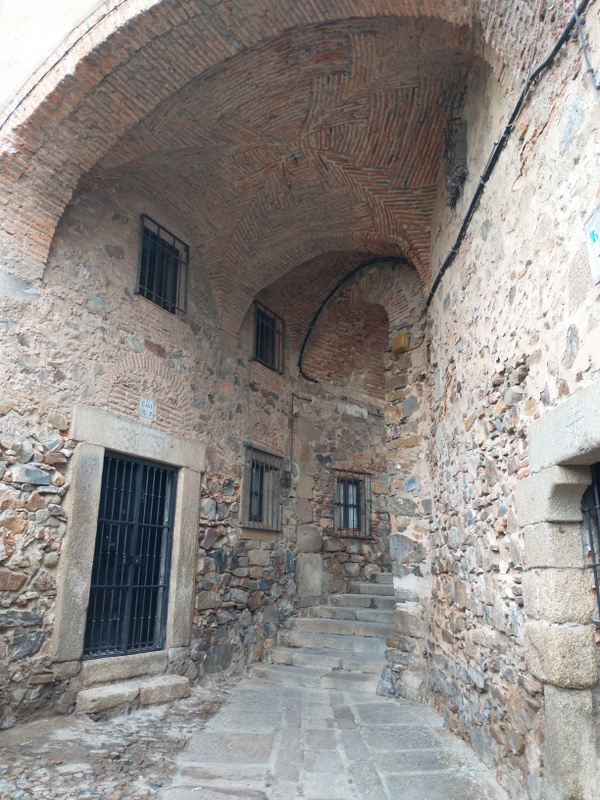
Photos: Plaza Mayor with the Torre de Bujaco on the left; View of the Plaza
Major from the tower; The bells ringing in the cathedral tower; An alleyway in
the old city; One of the many impressive doorways; A warrior Stele from the 9th
or 8th century BC showing a lance, mirror, brooch and comb at the
top, a shield in the middle and a sword at the bottom; The cistern under the
museum.




We had a relaxed start this morning as we had no stops
planned on our route to Caceres, only three hours away. It would have been two
and a half hours but we opted for the scenic route marked in green on our
Michelin map. We started with a long drive up the wide Adejo Valley with hills
on one side and, on the other side, mountains, some with a dusting of snow,
probably as a result of the recent rain that we had in Avila. Many more storks,
more large churches and small villages and red kites. For the second time, we
saw vultures – a ‘committee’ of vultures on the ground and a ‘kettle’ of
vultures circling above.
The valley narrowed and the road climbed through a series of passes until we entered
the region of Extremadura. The quality of the roads that had been excellent up
to then, definitely took a downward turn both literally and metaphorically. The
road descended in a series of hairpin bends to follow the river Jerte into its
valley. There were great views and the terraced valley sides were very
picturesque. It turned out that this area was famous for its cherries and it
was cherry trees that were planted on the terraces. The trees were bare at the
moment but in a few weeks’ time, the blossom will be beautiful.
Just beyond Plasencia, we left the main E803 road heading for a viewpoint and
castle on an island in a lake formed by the Tajo River. That was how is was
shown on our map and the idea was to stop there for a late lunch but we failed
to either the viewpoint or the castle. We stopped instead at a random derelict restaurant
next to a railway line and eat lunch there.
Camping Caceres is one of those very rare campsites that provides a private
toilet and shower for every pitch. When we unlocked out bathroom we found a
table and two chairs for our use. The site also has excellent WiFi and a
restaurant – all for €21 per night with the ACSI discount.
For the first time this holiday, we sat outside in the evening enjoying the sun
and the 18C temperature. The warmer temperature had something to do with the
drop in altitude – 459m here compared with 1182m. We were hoping for continued
warmth but the weather forecast looked anything but encouraging.
Photos: The Jerte valley from the Mirador del Puente Becedas viewpoint; The
terraced sides of the valley with the cherry trees; Our pitch at Camping Caceres.

There was a lot of rain during the night and, as it was
still raining over breakfast, we thought that we might not be able to do our
planned walk of the Avila walls. However, from 10:00 it brightened up and we
set off for the far side of the city, close to the cathedral. Here we found the
ticket office for access to the wall. Use of a QR code gave us access to an
audio guide in English. This was only a short section of the wall and the main
section started on the other side of the cathedral. We therefore decided to
walk the short section, have a coffee in a café and then visit the cathedral.
The cathedral took more time than we thought – another audio guide provided a
comprehensive visit and we, once again, admired the excellent wood and stone
carving and the architecture.
It was now lunchtime and we chose the Meson Tres Siglos in the area close to
the cathedral. There were a few tables taken when we arrived but it soon
started filling up and, by the time that we left, there was a queue waiting for
tables. A very good 3-course meal with bread and wine for €16.90 – excellent value.
The longer section of the walk took us down the western side of the city just
past the gate by our campsite. It was good exercise as there were lots of open-topped
turrets to walk up and it was certainly over 1.5 km long. The audio guide was
very good, giving lots of information about buildings both inside and beyond
the city walls. There was an exit at the far end and that gave Jane a short
walk back to the van whilst I walked a little further away to a viewpoint that
gave an excellent view of the walls and the city inside. And all of that was,
thankfully, achieved without any rain.
Photos: Avila cathedral altar and high vaulted ceiling; Two examples of the
beautiful stone carving; The Avila city gate by the cathedral; Walking the wall
down to the south-west corner; View of the city from the viewpoint on the other
side of the Adaja River.


We were heading to Avila today but did some essential
shopping at Lidl on the way. Our route took us on many arrow-straight roads
across the plains. Some of them might have been created by the Romans as our
first stop was at a Roman villa at Almenara de Adaja-Puras, known as MVR, the
Roman Villa Museum. The museum not only presents the excavated remains of a
large Roman villa but also explains Roman villas in general. I am a volunteer at
Avalon Archaeology in Somerset and I have been very involved in the creation of
a Roman mosaic for our Roman dining room, so I was very interested in the villa
mosaics. The excavated site is huge and is covered by a massive metal building.
Walkways above the ruins allow the visitors to see the site from above, which
is especially useful for the mosaics. The mosaics were very impressive,
although rather dusty – difficult to avoid when they are in their original position
and not indoors. We encourage visitors to mop our mosaic, which really brings
out the colours but museums are reluctant to do the same with the originals!
The photographs below have been digitally enhanced to make them look as though
the mosaics have been mopped.
In addition to the museum and the excavated site, MVR also has a very impressive
reconstruction of a Roman villa complete with a bathhouse, although I don’t
think that they ever fire-up the hypocaust.
Lunch was taken in the museum car park after it had closed at 14:00. On the
edge of the car park was a ploughed field and I wandered along the edge finding
large amounts of Roman pottery and tile. I suspect that the spoil from the
early (19th century?) excavations were spread on the neighbouring
fields.
We drove on and were entertained by large numbers of storks both flying and on
their nests. As on all of our journeys in Spain, we have saw lots of red kites
flying gracefully in the search for carrion. The other thing that we noticed
was the number of large churches in small villages and one was particularly
impressive with six stork nests on its roof.
Approaching Avila was a really ‘Wow!’ moment as the massive city wall came into
view. Our camping site, ‘Aparkarea Avila’ was just outside the walls but with a
wonderful view up to it.
It was early afternoon, so we had time to walk into the city through one of the
9 main gates. The 11th century walls of the city are complete with a
length of 2,516 metres, 87 turrets and reaching to an average height of 11
metres. They are the best conserved examples in the world.
After a wander through the streets we returned to the van for dinner. When it
was really dark, I took a walk to view the walls that had been beautifully lit.
Photos: The mosaic of an apsed room; Some excellent mosaic fish – much more
realistic than some in Roman Somerset; The mosaic in the foreground is very
similar to one that we laid at Avalon Archaeology – we nicknamed them ‘Jesters’
Hats’; The Roman triclinium (dining room); The Basilica of San Vicente just
outside the walls of Avila; The walls at night.


Jane decided to have a day at the campsite, what she calls a
‘poddle day’. I wanted to visit two museums in the city and so I caught the bus
in again, arriving just in time for the opening of the Museum of Human
Evolution. This is a very modern museum of huge size, housed in glass-fronted,
five-storey building. No expense had been spared, there were lots of staff on
duty and all of the exhibits had explanations in Spanish and English. For
oldies like me, entry was free!
Atapuerca is probably the most important prehistoric site in Europe and was
designated a World Heritage Site in 2000. They have found bones of early man
dating to nearly a million years and evidence of the earliest known settlement
of man in Western Europe. The museum has finds from a number of sites in the
Atapuerca mountains and the results of the excavations of two caves are shown
in dark, cave-like rooms. It was very impressive, especially coming
face-to-skull with a pre-Neanderthal man and a stone hand axe, both approx.
400,000 years old.
That part of the museum was excellent. The rest of the museum, unsurprisingly, covered
human evolution and was very well presented, although not of so much interest
to me.
The next museum was the Museum of Burgos. This had two sections, one devoted to
Christian art and the other to local archaeology. I have seen too much
Christian art and walked through that section fairly rapidly. There was however
some very good 15th and 16th century paintings in
excellent condition.
The archaeological section was excellent although they obviously didn’t have
the money that the Museum of Human Archaeology had. The displays were rather
old fashioned and all of the information boards and find tags were only in
Spanish. This made it difficult to follow but the quality of the finds,
especially those from Iron Age sites, was excellent.
Time was getting on and I just had time to look in at the indoor market before
it closed at 14:00. Both of the museums were on the opposite side of the river
from the cathedral and it was obvious that this was much more an area for the
locals with a large variety of independent, specialist shops.
I went back to the excellent Las Espuelas del Cid restaurant for lunch and had
another wander around the centre before catching the bus back to the campsite.
Photos: The 400,000 year old pre-Neanderthal skull; An even older 500,000 year
old hand axe; The courtyard of the Burgos Museum; One of the specialist shops
near the Burgos Museum – it specialises in cod!


There is a bus stop outside the campsite where four buses a
day will take you into the centre of Burgos for £1. We caught the 09:30 in and
headed to the tourist information office and obtained a brochure detailing
suggested walking routes around the city. We find this a useful way to explore
places and gives the opportunity to visit attractions on the route if they look
interesting. Unfortunately, this brochure only listed the sites rather than
showing a suggested route.
We started at the cathedral, a must-see site in Burgos. It really was
magnificent and we spent a couple of hours going around admiring the
architecture and wonderful stone carving. Another highlight were the choir
stalls with their wood carving and marquetry. The audio guide was available by
an app download and this meant that the peace of the cathedral was maintain.
Our combined ticket also covered two other churches, one of which was closed
today but we were able to visit the church of St. Gil, another fascinating
church but somewhat low-key when compared to the cathedral. It was British
lunchtime (13:30) and we had identified a restaurant close to the church. Las
Espuelas del Cid offered a 3-course meal for €20 and it was excellent.
Almost everything, shops, churches and other attractions close in Spain between
14:00 and 16:00 and our bus back to the campsite left at 16:00, so we decided
to have a wander to use up the time. We headed up to the castle (closed for
refurbishment) and enjoyed a great view over the city. We then followed a
circuitous route through the centre admiring the architecture and doing some
window shopping – much cheaper than the real thing.
Photos: The beautiful ‘Golden Staircase’ of Burgos cathedral; And an example of
some of the excellent stone sculpture; View of the city from Burgos Castle; All
through the city are wonderful bronze sculptures of everyday people and trades.


