Monday, 15 September 2008

Tuesday 9th September 2008 – Vrchlabi, Czech Republic


We set up the Garmin satellite navigation with our destination and drove off. Having suffered from a total lack of Garmin map detail in Bulgaria and Romania rendering the device total useless, here we had too much detail. The Garmin told be to turn left on a dozen occasions when there was only a dirt farm track or even just a grass strip between fields! Eventually we came to a proper asphalted road on the left and the Garmin was happy for the remainder of the journey.
We arrived at 'Euro Air Camp', Vrchlabi and discovered the reason for the name – it was on the opposite side of the road from an airstrip. There is a very active gliding club based there and we watched the majestic planes flying over the campsite to land with just a very gentle whooshing sound announcing their presence.
Photos: The Lone Fisherman at Otmuchow.

Thursday, 11 September 2008

Monday 8th September 2008 – Otmuchow, Poland


It rained during the night and the day dawned depressingly grey. This set the mood for our visit today. In rained most of the time during our journey to Oswiecim or, as it was known in German during the Second World War, Auschwitz.
The concentration and extermination camp known as Auschwitz actually consisted of three major camps and a large number of small satellite camps. The two largest camps Auschwitz and Birkenau are now a museum and it is this that we visited. It is actually free to visit the sites but we opted for a guided tour in order to get a better understanding of what happened there. We all know about the horrific extermination committed by the Nazis in the gas chambers, primarily at Birkenau, where an estimated one million Jews were taken straight from trains to their deaths. However the concentration camps were also used as forced labour camps for Jews, Poles (political leaders, dissidents, academics), gypsies and many others. An estimated half a million of these people were worked to death , died from disease or starvation or were executed by the Nazis. A few survived to tell the world about their treatment. I can't begin to describe the horrors that we discovered today and we kept asking ourselves “how could anyone do that to other human beings?”. It took four hours to tour the two sites and we came away very moved by what we had seen and heard.
We drove three hours to our next campsite, the romantically named 'Camping 42' at Otmuchow, close to the Czech border. It took us some time to locate the site as the ACSI map showed it in the wrong place and there was a total lack of signs in the village. However, the wording said that it was on the side of the lake and, having spotted a sign with a yacht on it, I followed it for about 3km and found the campsite. And very nice it was too. We parked up on the lakeside with a lovely view all along the lake. It was quite late and we watched the sun set over the water – a beautiful sight after the horrors of Auschwitz.
Photos: Flowers mark the end of the Death Railway at Birkenau.

Sunday 7th September 2008 – Krakow, Poland


Said “Guten Morgen” to a man from a German motorhome only to discover that he was South African and had hired the van. He had flown over from there to Munich, left his parents at the airport and travelled across Munich to pick up the van. He had then driven the large left-hand drive van (they drive on the left in South Africa) back across the city to collect his parents– he said that it was an experience and he was very glad that it had satellite navigation! His parents are both 80 and are thoroughly enjoying their holiday – you're never to old to start motorhoming! [Note to our parents: Please don't think that we are going to follow his example!]
There is so much to see and do in Krakow that it justified another day. We caught a slightly later bus in and got off the tram earlier in order to head for the Jewish Quarter of Kazimierz. When the Germans invaded they implemented their perverted plan to remove and then exterminate all Jews. Krakow had a particularly large Jewish population and, after a period of persecution, they were evicted from their houses and moved to a ghetto south of the river. Many of the houses were left empty during and after the war and this has lead to Kazimierz being preserved in a time warp, frozen in the 1930's. Many of the buildings have now been restored and renovated but they have been kept true to the period. There are a number of marked trails round the area and we followed some of these, referring to our guidebook for details of the sights. We came across a Jewish bookshop in one of the old synagogues and investigated. It had a huge number of English language books and we decided to buy one each. It took us ages to decide which ones to buy. In the end, Jane bought a small book written by a Krakow Jew who described life before and during the Nazi occupation. He was sent to a concentration camp and managed to survive as, remarkably, did his two brothers. The remainder of his extended family were killed. I chose a larger book that told the story of a Polish Jew who had managed to avoid capture during the whole of the war.
There was a good choice of places to eat and we sat outside the Hotel Rubinstein and had one of the best meals of the Odyssey (apart from the ones that I cook, of course). We had the set three-course meal for 32 zloty (approx £6.50) and when the home-made bread and butter topped with pink peppercorns arrived, we knew that it was going to be good. The beef soup with noodles was light and very tasty but the main course was superb – char-grilled chicken breast in a balsamic sauce served with white and green french beans and potatoes. It was beautifully presented and was so tasty – I enjoyed every mouthful. The desert was an ice cream sundae, which we assumed would just be straight ice cream but when it was served we had cream, sorbet, ice cream and lots of fresh bilberries and raspberries – absolutely gorgeous. Next time that you are in Kazimierz, head for Hotel Rubinstein. An interesting bit of trivia is associated with this hotel, it spreads over two buildings one of which is the house that Helena Rubinstein (entrepreneur and founder of the huge cosmetics company that bears her name) was born in and the other is where Helena Rubinstein said she was born. See the photograph for details.
We crossed the river to take a quick look at the ghetto area where the Nazis moved the Jews. Most of this area has been redeveloped but some original building exists, including the pharmacy where the doctor was the only non-Jew allowed in the ghetto. Dr. Pankiewicz did all he could to help the Jews during this time, not only looking after their medical needs but also providing protection for those trying the evade deportation to the death camps. The small house is now a museum with a thought-provoking exhibition about the life and death of the Jews in the ghetto. We also saw a section of the ghetto wall that still exists. The Nazis forced the Jews to build the wall all around the Ghetto – any Jew found outside the wall without permission was shot.
We discovered that one of the trams that connected with the bus back to the campsite actually ran through this area so we caught one and were soon back with Henrietta. Jane settled down with her new book and read the whole of it before we went to bed! It is a good job that the one I bought is 420 pages – that should take her a little longer.
Photos: The white building in the picture (minus the top two floors that were added recently) was where Helena Rubinstein said that she was born but she was actually born in the house to the right of that (with the umbrellas outside). She explained this later by saying that she felt that her real birth place looked too modest and therefore adopted the grander house next door. Both of these house were still derelict in 2000.; The wailing wall of the Remul'h cemetery built with the fragments of the gravestones smashed by the Nazis; Nuns in step by the Wisla River.

Saturday 6th September 2008 – Krakow, Poland


When we registered, we were given a card that advertises the campsite on one side and on the other side shows the numbers of the buses and trams that you need to get into Krakow – very useful. Reception also had a list of all of the bus times so we were able to time our short walk to the bus stop to catch the 09:21. At Salwator we changed to a tram and got off just a short walk from Wawel, Krakov's castle hill. There are lots of different parts of the castle (really more of a palace) and each part is paid for and time slots allocated separately. We decided to visit the 'Lost Wawel' and the state apartments, getting slots for 11:00 and 11:40 respectively. This gave us 40 minutes to visit the cathedral before we were due at Lost Wawel but fortunately there was only a very small queue for the cathedral tickets and we were soon inside. Krakov was the ancient capital of Poland and, although it didn't remain the capital, almost all of the Polish kings were crowned and buried here. The cathedral is very ornate and the nave is lined with chapels to kings and aristocrats with wonderful stone carvings. This also applies to the many tombs of Polish heroes in the crypts below the church. The centrepiece of the church is the magnificent Shrine of Saint Stanislaw, topped with a huge, ornate, 17th century silver sarcophagus. Bishop Stanislaw refused to agree with the ambitions of the king and so the king had him beheaded in 1079.
Forty minutes was plenty of time to visit the small but fascinating collection of exhibits in Lost Wawel. The most impressive exhibit was the remains of the Rotunda of Saints Felix and Adauctus dating to 1,000 AD with its base a good 5m below the current ground level. We arrived at the state apartments a little early but this did not seem to matter and we were allowed in immediately. We were lucky to come across a group of four people with an English speaking guide and as they we going around the rooms at the same pace as us (a pure coincidence, of course), we were able to here much of her talks and she was very good. The number and names of the kings became a little blurred although I did like the ones with names such as '... The Bashful', '... The Shy' (perhaps they were the same person?) and '... The Great', '... The Short' (definitely not the same person!) and 'Augustus The Strong', so called because he fathered over 300 children – I think that 'fathered' is probably the wrong word as he must have 'loved them and left them' in most cases and I am surprised that he isn't known as 'Augustus The Knackered'. The art was very impressive with excellent paintings and tapestries – Krakov, despite Nazi plundering, is actually full of art – over 2.3 million works according to our guidebook (Anthony please note – a possible trip for Strode College?). The culmination of the art was a temporary exhibition of the recently restored masterpiece 'The Hommage of Prussia' by the Polish artist Matejkos. It is a huge, beautiful painting full of figures and detail – the sort of painting that one could visit time and time again and always see something different. We stayed there for some time and I would have dearly liked a poster of the painting but the castle shops didn't stock them – we could however have bought any number of stuffed, cuddly Krakow dragons!
Krakow has the largest (200m by 200m) Mediaeval square in Europe and, unlike most European capitals the main square and the rest of the city were spared in the Second World War. The Nazis did not bomb it because they wanted it as a regional capital and the Russians encircled it so quickly that the Germans did not have time to explode the mines that they had set up all over the city. On our way from Wawel, we came across a number of marching bands and following them they took us into Mariacki Square. It appeared that the Krakow fire service was celebrating a ninetieth anniversary of something. We left the bands standing in the centre of the square and went of to visit the Mariacki church. It was just coming up to 14:00 and we stopped to watch the trumpeter sound the hour. Legend has it that a watchman in one of the church towers spotted a Tatar raid approaching and sounded the alarm on his trumpet but was stopped by an arrow through the throat. Now, every hour, a trumpeter sounds the 'hajnal' melody from the tower stopping in mid flow at the point that the watchman was killed. He does this four times from each of the four sides of the tower, finishing with a wave to all of the spectators. Strangely, it is a very pleasant tune and doesn't seem at all the urgent call that you would expect to announce the danger that was approaching. The interior of the church is very pretty, especially the altar and choir area where a series of thin brightly coloured stained-glass windows soar to the arched, blue-painted roof and carved wood panels cover the walls. There was a wedding in taking place in this roped-off area and we watched the service whilst in between admiring the rest of the church. During the service a lady soprano sang occasionally and she had a wonderfully pure voice. I couldn't work out where she was but Jane pointed her out high up, right at the back of the huge church next to the organ. She sang effortlessly and yet the sound filled the church – quite magical. The ceremony finished and the bride, groom and congregation left but a couple of minutes later the congregation returned. This had us somewhat confused until we realised that this was the next wedding – no time was wasted! We returned to the square and watched the marching bands play for a while but the baton twirling and the pompom waving got on my nerves. I have to admit to an aversion to pompom waving that set in during a visit to Staffordshire County Show in the mid 70's. We were living in Stafford and decided to visit the show that was held in the town. I was delighted to see that there was a major 'Morris Dancing' section and we headed off to see it. Now I was brought up in Dorset where Morris Dancers are Real Men, hard drinking, wearing fancy costumes, bells on their ankles, waving handkerchiefs whilst they dance and attempting to bash each other with long wooden staves. However, I was horrified to find that the Morris Dancers in Staffordshire were little girls with pompoms performing dance routines. To make it worse, it was a competition and the seemingly endless troops of dancers performed to the same piece of music – 'The Entertainer', which was very popular at the time. Even after we had extricated ourselves from the audience, we continued to hear that tune drifting across the showground for the rest of the day. Every time that I hear that music, even to this day, I have horrible visions of little girls with pompoms.
We wandered around the old town and then returned to the square to find that the speeches were taking place. That signalled the end of the event and the bands marched out of the square. It was another hot day so we found a shaded table at a café on the edge of the square and ordered a coffee. We spent a very enjoyable time watching the comings and goings on the square, particularly enjoying the procession of brides and grooms in horse-drawn carriages. There are many of these carriages in the centre of Krakow but the white ones were definitely the prettiest.
Photos: Wawel Cathedral on Krakow's castle hill; One of the marching bands on the way to the celebrations in Mariacki Square – this one was all too American and the lead twirler could switch on the most awful plastic smile; The beautiful interior of the Mariacki Church – you may be able to spot the bride and groom kneeling in front of the altar.

Friday 5th September 2008 – Krakow, Poland


There were some places further south that we would have liked to visit but we didn't know of any campsites in the area so we decided to push on to Krakow. This involved travelling 200km (120 miles) on major roads and we soon remembered why we normally avoided them. There was lots of traffic, lots of lorries, roadworks and hassle. The initial part of the journey was especially frustrating with many queues caused by the roadworks and towns that would soon have by-passes but hadn't yet. We nearly turned off on more minor roads but after Tarnow, the road improved.
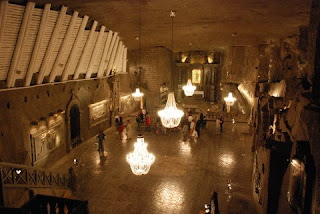
We arrived in Wieliczka, a small town close to Krakov, shortly after 14:00 and after parking Henrietta we hurried to the local mine. Not coal, gold, silver nor any other precious metal but something of huge value in the Middle Ages – salt. At one time salt provided one third of the Polish state income and it was incredibly important to them. The salt was deposited some 13 million years ago when the sea in this area evaporated. Archaeological excavations in the town have uncovered evidence that 6,000 years ago the Neolithic inhabitants were boiling water from the local brine springs in order to produce salt. The springs dried up in the early Mediaeval times and wells were then sunk to collect the brine. In 1280 they started to mine the salt and after extracting 7.8 million tonnes using 12km of tunnels mining stopped in 1996 when the mine suffered a major flood, caused by the mining activity, that resulted its closure for over a year. A small amount of salt is still produced but only from the brine that is pumped from the mine to prevent it flooding. The mine has been a tourist attraction for hundreds of years and has attracted a host of celebrities including many European monarchs (the mine was owned by the Polish Royal Family), Copernicus (the astronomer, educated in Krakow) in the 15th century and Pope John Paul II both as a schoolboy (he was born locally) and when he was Archbishop of Krakow. John Paul was also due to visit as Pope in 1999 and all the preparations had been made, including a special vehicle to take him from the lift to the King's Chapel, but he was too ill to travel.
We had to wait for half an hour for the next English language tour but were soon walking down the seemingly never-ending 380 steps. The first impressions of the mine were nothing like coal mines nor the gold and silver mine that we visited last month in Slovakia. It was clean and dry and the walls shone like marble. The deposit is rock salt and it is as hard as rock, with the miners using wedges to split the rock just as they used to with marble and building stone. In the early days, the salt was broken up and transported in barrels and later, large slabs were often shaped into cylinders to allow them to be rolled the long distances to the shafts. The salt was known by the miners as 'green salt' because, in the yellow light from their tallow lamps, the grey salt looked green. The salt is of a high purity and can be used without the need for refining – we were told that every visitor was allowed to eat salt from the walls on the way up to a limit of 2kg! The salt sculptures were however out of bounds. These were all made not by professional artists but by the miners themselves and were very impressive. They included kings and queens and many of those celebrity visitors but the highlight of the visit had to be the King's Chapel, a vast hall created in the rock salt. There was the altar, alter screen, columns, statues of the crucifixion, the Virgin Mary and Pope John Paul II and many relief sculptures of biblical scenes such as the Last Supper lined the walls. Everything, including the floors, was carved out of the rock salt – it was quite awe inspiring.
The tour ended in another large hall where there was a state of the art conference hall and large restaurant, all over 100m below the surface! We were told that, included in the ticket, there was an optional tour of the museum with the same English-speaking guide that would leave in 15 minutes time – we were the only two people out of the 40 people on the tour to take up the offer. The museum was fascinating with exhibits such as samples of crystallised salt (including a blue and white sample of pure salt, the colour resulting from a distortion in the crystal structure); the narrow gauge railway used to transport royalty and visiting dignitaries; models of the mine and a number of huge horse-powered winding mechanisms. The museum is on the third level at 135m and is the lowest part of the mine open to the public, but the mine actually reaches a level of 327m at its deepest part. As we had the guide all to ourselves, we were able to chat about lots of subjects as we wandered through the tunnels. I asked about the number of employees and was told that there were 700 – a similar number to Foster Yeoman that ran two quarries producing over 5 million tonnes of rock each per annum! Given that the mine is no longer producing, I found this rather surprising although it did help to explain the £13 ticket price. There was an army of cleaners (the whole of the tourist route was cleaned every day and we saw a number of cleaners in the museum) and the mine, even the areas not visited, had to be maintained but I was still struggling with the concept of 700 employees. Our guide took us to the lift cage that took us rapidly back to the surface. Our visit lasted for a total of over three hours and was actually good value for money even though it was the most expensive attraction that we have visited on the Odyssey.
We had a surprisingly easy drive through Krakow to our campsite that was on the eastern outskirts of the city. Camping Smok is set on a hill but has level pitches and very good facilities. The site is sprinkled with apple trees and, having been guided to a pitch under two trees, we were sprinkled with apples. Actually, 'bombarded' might be a better description, as they made a terrific noise when they fell on the van, especially on the bonnet where the greater drop allowed them to reach a higher speed. I thought about suing the campsite owners if they created any dents in Henrietta but in the end I decided just to eat the apples.
Photos: Some of the skansen buildings at Pastewnik Camping; One of the many salt sculptures in the mine; The very impressive King's Chapel; The train main for the King and subsequently used to transport important visitors, sadly not including us!

Thursday 4th September 2008 – Przeworsk, Poland


We plotted a route that would take us down into the very corner of Poland and then on a picturesque road up a valley to a large lake. The journey south east to Ustrzki Gorne and north to Czarna Gorna was gorgeous – spectacular scenery and riddled with well-used hiking trails. We knew that the area was very popular with hikers and we saw many of them. Car parks had been created close to the best routes and there also appeared to be a good bus service. The scenery is not as dramatic as the High Tatras but the walking would have been very enjoyable without being as strenuous. Certainly an option for a future visit.
Things went somewhat awry when we arrived at Czarna Gorna – the road that we wanted to take was closed. The suggested diversion cut out all of the route that was marked as picturesque on our map, so we headed north instead. By the time that we arrived at our next campsite at Przeworsk we had travelled through four national parks, Bieszczady, Doliny Sanu, Gor Slonnych and Pogorza Przemyskiego. All were pretty but the best were Bieszczady and Doliny Sanu, which were both in that first section, in fact we didn't even notice the join between them.
We were surprised to find that the campsite in Przeworsk (Pastewnik Camping) was actually a skansen (a collection of reconstructed historic buildings). We had visited a number of skansens on our travels but had not stayed in one. Old wooden buildings were scattered over the site and it was even possible to stay in them for as little as £20 for a two-bedded room. It made a very pleasant outlook for our pitch.
We took a short walk into the town to investigate it and then returned to Henrietta to sit outside in the shade. It was a hot day (27°C) with a strong, very warm, southerly wind but as the sun went down the wind died completely. It was too warm to be inside and we ate dinner outside as it got darker and darker – the last mouthfuls were located by touch and smell rather than by sight!
Photos: This Polish wooden church was of a completely different style to those on the Slovakian side of the border; This church (and monastery) in Przeworsk, close to the campsite, had some of the original Mediaeval wall around it – it has also been visited by John Paul II – we were still following in his footsteps; Apparently these Przeworsk elephants are famous but we never established why – they are in a rather sorry state and may attract the attention of the RSPCA.

Wednesday 3rd September 2008 – Wetlina, Poland


The first anniversary of the start of the Odyssey – it is difficult to believe that it is one year ago that we set off from home on this fantastic trip.
We had read about the isolated south-east corner of Poland and decided to investigate it. Our route took us north over the Dukla Pass, which sounds dramatic but is actually very low at 500m and there weren't even any really steep hills on either side. It did however achieve notoriety in the Second World War when it was fought over with huge losses on both sides by the Germans and Russians. We passed a German war cemetery and monuments to the Russians and their allies; there was military hardware on display at the sides of the roads – tanks, field guns and even aeroplanes.
We had passed a number of beautiful wooden churches on the Slovak side of the border and these continued to be a feature on the Polish side, including a new one that was under construction. Needless to say the scenery was dominated by forest although, on the Polish side there were also large areas of pasture at the lower levels. We passed a preserved narrow gauge railway that offered a 36km round trip for a very reasonable price, but only at weekends in September.
Our ancient Rough Guide to Poland mentioned a campsite at Wetlina and we headed for that although there seemed to be plenty of options on the way. The campsite that we found was small and basic but was acceptable and at £8 for the night we weren't complaining (although that was £8 more than last night's!). We even had electricity, fresh water and grey water disposal at the side of the pitch – a real rarity.
Photos: Ladomirova church spires – one of many wooden churches on the Slovakian side of the border; Some of the military hardware on display in the Dukla Pass; A new wooden church being built on the Polish side of the border.