Friday, 20 November 2009

Thursday 12th November 2009 – Padula, Italy


There is a distinct lack of open campsites at this time of year and so we decided to stop again at our restaurant, Aia Antica, in Padula. This gave us a simple drive across the arch of the foot and up on the A13 motorway. This stretch of motorway is quite beautiful, rising to 1,000 metres, the views of mountains, valleys and hillside villages are lovely. At one point the motorway runs in tunnels directly below a castle.
We arrived just after 13:00 and found the restaurant open and it seems to be open lunchtimes and evenings all week. This is probably because of its proximity to the much-visited Carthusian monastery of St. Lawrence. We decided to go for lunch rather than the evening meal and were treated to another excellent feast.
On our last visit we only made it as far as the monastery, so this time we decided to climb up to the town resting on top of a hill. The walk up gave us lovely views of the monastery, the valley and the show-clad peaks of the mountains opposite. The town had been defended by a wall and we some of the gates were still in position even if the walls themselves had long disappeared under houses. The perfume of wood smoke filled the air as we wandered through the maze of steep, narrow alleyways that made up the old town. We saw a museum dedicated to Joe Petrosino who we later discovered was born in Padula and emigrated to America where he became an anti-Mafia policeman based in New York. A number of films and many books have been written about his life. He was murdered in Sicily by the Mafia when he travelled there in pursuit of one of the New York Mafia bosses.
On the way back down from the top of the hill we found the Anunnziata church and it became clear that this was a fortification at one of the city gates that had been converted into a church. The front elevation looked just like a town and there was evidence of a large, now filled-in, doorway part way up the wall on the side. In the square here stood a monument to Joe Petrosino.
It was now getting dark and we had to head back so that we could negotiate the country lane and unlit drive to Ai Antica whilst we could still see something.
Photos: One of the alleyways in Padula's Old Town; The Anunnziata church; A view of the Monastery of St. Lawrence with Aia Antica looking rather elegant in the field behind the church. Examining other photographs, it became obvious that Aia Antica used to be associated with the monastery as a drive runs from the monastery, through a gate and directly to Aia Antica.

Wednesday 11th November 2009 – Roccelletta di Borgia, Italy


We had a relaxed start as we weren't intending to drive far today. The views of the mountains were even better than yesterday and we decided to stop at Ferruzzano Marina to take a walk along the promenade. It turned out that this would have been an ideal free camping stop as there were two motorhomes already in position and, surprisingly, three caravans that had obviously not moved for some time. We wandered up and down the prom enjoying the hot sunshine and noting that the long beach of white sand was a protected turtle breeding ground. We set off again but soon stopped near Bianco when we saw remains and a sign to a Roman Villa. The site had obviously been given a makeover recently with a new visitors' centre and covers over much of the site. Judging by the photographs outside the site, there were some very good mosaics but we weren't going to see them because the site was only open for a few days of the week during August.
The rain that had been lurking over the White Mountains, making them appear as the Very Grey Verging On Black Mountains, now caught up with us and there was a mixture of showers and sunshine for the rest of the day.
We had established that there was a camperstop / campsite at Marina di Davoli that was open all year and, encouragingly, we past a number of direction signs for it. However, despite the fact that all of the signs declared “Open all year”, it wasn't. We drove in the open gates and then had to back out again after we were told that it was closed because they didn't have any water. It looked as though it was generally open but they were doing some repairs at the moment. We had a plan B and drove a few miles further on to Roccelletta (also known as Roccella) where Camping Camello Grigio was open even if we turned out to be the only people staying. We sat in the van drinking tea looking over the beach to the sea and a double rainbow that had appeared after the latest shower.
Photos: The turtle beach at Ferruzzano Marina.

Tuesday 10th November 2009 – Condufori Marina, Italy


We drove the short distance up the steep hill to the ancient site of Tindaris but had to park in a huge car park well below. The reason for this is the the site is much more famous in Sicily as the site of the Black Madonna, kept in a huge sanctuary specially built in the 1960's. Large numbers of pilgrims come to pay homage to the statue that originated from the East and is claimed to have performed a number of miracles. Whilst we were there, there were four coaches, include two of school children, and many other individuals were filing in and out of the church.
The large number of children who had just arrived made us decide to look at the archaeological site first. Tindaris was one of the last Greek sites in Sicily, flourishing even in Roman times when they were grant special privileges. Much of the ruins are from the Roman period with a large villa with excellent mosaics. The impressive Basilica stands tall at one end of the site although this was reconstructed in the 1950s. The whole hilltop was occupied, surrounded by impressive defences that, together with the steep slopes, made the city virtually impregnable. Much of the ancient city is covered by modern housing, the ground floor of many of the houses are now tourists shops mostly selling religious souvenirs including incredibly naff copies of the Black Madonna. It is always strange to see modern houses next to and sometimes incorporating the walls of an ancient site.
Returning to the church, we were able to visit it all on our own apart from a novice nun who was cleaning the floor in front of the altar. We were quite impressed by the church – huge mosaics lined the walls showing scenes from Christ's life and the ceiling held a painted scene of a, strangely white, Madonna and Child attended by angels clutching rosary beads.
It was only late morning so we decided to take the motorway to Messina and catch the ferry back to the mainland. This went surprisingly easily - the city traffic wasn't too bad and the ferry was very efficient with no queue at all. We left Sicily covered in black cloud and landed on the mainland in glorious sunshine.
I had found an Agroturismo site in Reggio, one of those where it is free to stay if you have a meal in their restaurant. This was useful because we wanted to go to the museum in the city centre to see its fantastic finds and we couldn't find any campsites close to the city. I put the address into the sat nav and was surprised to find that it was in the centre and close to the museum. We followed the directions into the centre but there was no sign of the restaurant. We found a car park close by and parked up. I asked a parking warden if he knew the restaurant and he identified the picture shown on the restaurants entry as a place just a hundred metres away – easy! Unfortunately there was no sign of the Sant'Anna restaurant, so I walked into another restaurant and asked if they knew where it was. A great discussion followed and it became clear that we were where the picture was taken but the restaurant was somewhere else. We decided to leave Henrietta where she was, go to the museum and ask them or the Tourist Information Office to direct us to Sant'Anna. We walked the couple of hundred metres to the museum that was covered in scaffolding. Finding the entrance to the museum we read the notice that we translated as “The museum remains closed for renovations”. We have encountered such a notice so many times and, of course, there is never any indication as to when it will be re-opening. One thing for sure is that we weren't going to see it on this trip.
With no need to stay in Reggio we headed South going around the toes of Italy's foot, an area that we didn't visit on The Odyssey. The mountainous interior here is know as the Aspro Monte (White Mountain) National Park and looks very pretty but we stuck to the level coast road with the sea on our right and the white mountains on our left.
There are very few places to stay on this stretch but we had found another Agroturismo site in Condufori Marina. It was another restaurant but without the free stay option. It was a curious site in the large garden of the restaurant owners house on the opposite side of the road to the restaurant. It was very basic but did have electricity and would be ideal for a train enthusiast, as the railway line ran along the bottom of the garden. Fortunately the trains don't run at night.
Photos: A 3rd century AD mosaic from a Tindaris villa's baths showing the three-legged symbol of Sicily; The Basilica at Tindaris; The view from the Tindaris Acropolis – perhaps the quarry is where the Tindaris stone came from; The Black Madonna – the non-PC inscription underneath translates as “I am black but beautiful”; Leaving Sicily as the storm clouds gather.

Monday 9th November 2009 – Oliveri, Sicily, Italy


Camping Rais Gerbi would make a good base for a longer stay – plenty of space, good facilities (including a restaurant open out of season), a pleasant local town with plenty of shops and good options for trips with buses to Cefalu and Palermo and access to the interior and the area around Mount Etna. There is also a station 3 km away that would give more options. The railway actually runs through the campsite but it is in a deep cutting, muffling the noise and the trains don't run during the night.
It was time to leave Finale and we had planned our last archaeology visits before we left Sicily. Two sites were mentioned in our guide book but we had spotted another on the Michelin map earlier on our route. As the Michelin map also shows sites that are not open to the public, we agreed that we would only go to the first site if it was signposted. We we reached the area we found a sign indicating the site, Halaesa, was 3 km off the road so we set off along the side of a wide valley soon climbing steeply. We found the site open and parked up outside the gates. Walking past a deserted ticket office, we started investigating the site inspecting first a small Roman necropolis with a tomb in excellent condition. We then followed an ancient road up to a large building further up the hill. This was a 17th century monastery that now housed the ticket office and a museum. The five staff in the ticket office seemed surprised to see us, we were certainly the first visitors of the day an probably the first for a week!
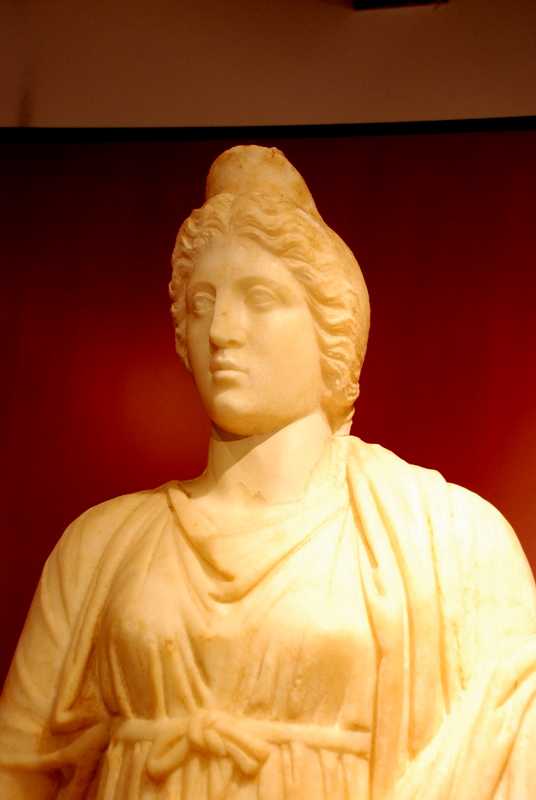
We visited the museum first and after showing that we were interested in the displays, the custodian volunteered some information in English. His English wasn't very good but he gave us a good tour of the two rooms and told us things that we would never have been able to establish from the Italian information boards. One find was fascinating and an archaeologist's dream. In the 17th century two fragments of a Greek tablet were found and they described the town in some detail. It split the site into areas and listed the important buildings in each. The archaeologists have established where each area is and now now exactly what lies buried in each! Less than 5% of site has been excavated and it will keep them busy for many years. It is only possible to visit part of the site but we followed an ancient road in better condition than most modern Sicilian roads up to the Agora (market place). Here we could see the shops around the edge and a cast of the beautiful statue of Cerere in its original position, the original being displayed in the museum. We then walked on to the site of the theatre, only a rear wall of which is currently uncovered. It is however possible to see the position of the stage set way down the very steep hill. The custodian had told us that the theatre is likely to be excavated next year and the indication is that it was able to seat over 5,000 people. The view over the river valley, the position of Halaesa's ancient port and the sea is lovely. We weren't able to go up to the acropolis and the Temple of Apollo, which was a shame.
A major diversion caused by a road closure delayed us but we eventually got to our second site, the Patti Marina Roman Villa and were greeted by another group of 5 bored custodians. This is a huge villa of a very wealthy Roman and had quite a long history undergoing a number of modifications. Unfortunately, it is in poor condition, the many damaged mosaics being covered in dust and difficult to see. It was obvious from the small areas where water had dripped on to them that the mosaics were in lovely colours but it was difficult to appreciate them when they were so dull. Collapsed pillars had often been left in position over the mosaics and we couldn't quite understand why. Surely, once they had been recorded, they could have been removed? Frankly not worth the visit.
We had planned to visit Tindaris this afternoon but time had run out so we went just a few minutes beyond to the campsite, 'Villaggio Turistico Marinello' at Oliveri, under the hill that Tindaris sits on. The site is covered with very tall trees providing welcome shade in the blazing heat of the Summer but making it very gloomy at this time of the year.
Photos: Halaesa Roman necropolis (2nd - 3rd century AD) that would have looked like a mini temple with a triangular pediment – the niches held cremations in urns that were still in place with funerary offerings when excavated; Halaesa - the beautiful 2nd century AD statue of Cerere; The museum in the 17th century monastery – the monks didn't have such a bad life - this was the their winery and still has the presses in place – the hole in the floor is where the wine was stored; The position of the Halaesa theatre – the flat area in front of the large concrete car park is the stage.

Monday, 9 November 2009

Sunday 8th November 2009 - Finale di Polina, Sicily, Italy


The morning was spent relaxing and hoping that it wouldn't rain so that the wet clothes and shoes would finish drying. It was windy and, at 16°C, quite warm so the clothes did dry although the wind made it feel quite cool and we decided to have lunch in the van. Just after two o'clock we walked into the village ready for the three o'clock start of the folk groups in the 23rd Finale Olive Festival. We were early and decided to have another walk around the town and inspect the stone town built in 1500. There is a pleasant esplanade build around the tower with plenty of benches, even if they do face the town rather than the beautiful view over the sea.
Just before 15:00 we returned to the square in the main square where the action was scheduled to take place. It looked the same as when we had passed it earlier – no crowds, just a few people milling about preparing stalls. I tackled someone (metaphorically only) and asked them about the folk groups. It transpired that the 15:00 start was more like 15:00 to 15:30 and it was a procession that started from the church. We hadn't found the church so we went in search and soon found it set back inland from the main street. This area looked even more dead than the square so we wandered off towards the sea for a while. When we returned, we found the only bench empty and occupied it to watch the inaction. It was a fascinating occupation watching the municipal police trying to look important and moving the occasional vehicle on when it tried to park in the wrong place. This sounds as if things were happening but for the first half hour, nothing did. The important and very pleasant man who we christened 'The Mayor' was there with his camera and seemed to know or be related to everyone who passed. There were many greetings and much kissing, except by the police as it is obviously not correct to kiss people when you are in uniform. Eventually, cars arrived with people dressed in traditional outfits and they were directed to an area behind the church.
The Greeks occupied Southern Italy and Sicily for many years and their genes obviously still permeate the local population. The 15:00 was definitely Greek time as we know it, as the procession didn't form until after 16:00. There were three folk groups from the local area though none were from Finale itself. The first had an excellent band playing in front of them but didn't seem to dance. The reason for this became apparent as 10 minutes into the procession a large number of people joined them – they had arrived even later than all the others. They then performed the most complex of dances and together with the excellent music, they were most entertaining. The third group carried a maypole and performed intricate dances around it, winding the ribbons into complex patterns around the pole and then unwinding them perfectly. The second group were also very good performing traditional dances and singing traditional songs.
The procession followed a route inland from the main street and then on the seaward side before coming up the main street to the square. The procession was marked by frequent stops when one or more of the groups would perform a dance and / or sing at a suitable distance from the other groups. It was great fun watching them and watching the spectators, many of whom were extended family groups viewing from their front doors, balconies or windows.
In the main square the groups took in turns to perform although it was very difficult to see anything due to the crowds, so we walked to the bar opposite the tower and had a glass of wine. At 18:30, food was due to be served in the square but, given the timing of the procession, we didn't expect anything to be happening by then. We were wrong. When we arrived just after 18:30, eating was in full swing. The first stall we came to was offering their newly pressed olive oil with bread – it was very good. Then we were given a cup of red wine and a plate of bread, green olives and cheese – all local produce. There were 20 twenty very large, juicy olives that had been marinated in garlic and chillies and with the bread and lovely cheese it was very filling. Next came the pasta. Jane got her helping but I only got a few pieces before it ran out. I was told to wait for the next batch and I eat the little that I had been given. It was it a simple tomato and olive sauce and was very pleasant. Ten minutes later I received my freshly cooked portion, which was very hot, not only in temperature but also in spice. My mouth was positively tingling by the time that I finished it. All of this was totally free and delicious.
The 'Mayor' caught my eye as I was wandering around and insisted that I tried some of the bread and sun-dried tomatoes. It was lovely and I was now thoroughly stuffed. I decided to take some photographs of the pasta chefs at work and met the man who ran the fast food stall at the olive festival 'Da Nino Il Mago Del Panino'. He sold all sorts of food on his stall but the highlight was the stuffed suckling pig cooked in a wood-fired oven. Another possibility for my oven when it is completed although I will have to find out where I can get a suckling pig. We (the owner of the stall, not the pig) hit it off well and he gave me a glass of his Sicilian frizzante, a medium-sweet slightly-sparkling wine. It was very pleasant. I admired his van and was soon given a brochure from the firm that built his van, just in case I wanted to take one back to England.
The evening finished with me thanking the 'Mayor' for an excellent festival and we set off back to the campsite complete with a litre bottle of that lovely, freshly-pressed olive oil. It was just after 20:00 but felt more as if it was 23:00!
Photos: The Nazo Folk Group with their excellent band; I Terrazzani pose by the tower; Spectators at the festival; One of the musicians of 'Ballo Pantomima Della Cordella' with their maypole dancers in the background; The pasta chefs insisted on posing!; The suckling pig's hat needed adjusting – note how it matches its owners hat!

Sunday, 8 November 2009

Saturday 7th November 2009 – Finale di Polina, Sicily, Italy


Happy Birthday Mum – I am not allowed to mention that she is 83 years young today.
We wanted to investigate the local town of Cefalu (pronounced like a cook with a weak bladder – Chef-a-loo). The good news was that there was a bus that would get us there. The bad news was that it left the campsite at 07:25. We set the alarm for 06:30 (this was supposed to be a holiday!) and were at the bus stop before 07:20, which was a good job as it was early.
Cefalu is on the coast with the old town set under a huge rocky outcrop known appropriately as 'La Rocca'. The modern town sprawls rather untidily inland but the old town is very pretty with the cliffs of La Rocca as a backdrop. We were too early to climb La Rocca as it didn't open until 09:00, so we headed for the Duomo that opened at 08:00. The guidebook said that we should get there early to avoid the coach loads of tourist and we certainly did that. Roger II built the Norman Cathedral in 1131 and it boasts the oldest Sicilian church mosaics, created in 1148. These are similar to and perhaps provided the inspiration for those that we failed to see in Monreale. They cover a much smaller area than Monreale but are nonetheless very impressive with their gold background.
It was still too early for La Rocca so we headed for the weekly market held well outside of the old town probably because the old town is too crowded to fit it in. On the way we stumbled upon the fascinating Saracen washing area. We had an enjoyable wander through it buying nothing although I was tempted by the very long silver eels coiled up in boxes. A strange vegetable also caught my eye – like a giant chilli or a very thin cucumber, over 1 metre in length.
It was time for the long climb up La Rocca where we were met by the custodian near the gate. He booked us in, confirming our nationality and warning us to only go as far as the church and temple as the rocks above were dangerous when wet. The weather was overcast but it hadn't rained yet – he obviously knew something we didn't. We admired the 'Temple of Diana' shown as 5th century BC but actually a much earlier construction built of Cyclopean blocks and probably a 9th century BC temple to Artemis. It had been modified in the 5th century to add classical doorways and had been used much later as a church. The views over the old town were lovely and we spent some time looking out over the town and sea whilst phoning my mother to wish her a happy birthday.
It had started to rain and we soon understood the custodian's advice as the limestone, full of intriguing fossils, became very slippery and we had to descend with care. We just got out of the main gate, still well above the town when the heavens opened. It poured down and we were stuck in the open. We sheltered as best we could under the trees but the rain soon started coming through and we ran down to try to find some proper shelter. We ended up huddled together on the doorstep of an old building on a steep street, legs either side of pot plants and pressed against the door to try to avoid water coming down and splashing up. And then the rain got heavier still with the narrow street funnelling the water from La Rocca down into the town. We couldn't move – the street was a fast flowing river with the water 2 cm deep. Further down the street we could see water cascading down the steps of a joining street, doubling the volume of water. We were trapped there for over 20 minutes until the rain finally subsided and the water level in the street dropped. All ideas of further investigation of the town were dismissed – we were drenched and as quickly as we could we found a restaurant to have a leisurely meal. It was an excellent meal but when we left after one hour we were nearly as wet as when we arrived. The bus left at 14:00 from the train station and we shared it with all of the college students who must have been amused to see the two drowned tourists.
Back at the campsite we changed into dry clothes, arranged the wet clothes (including those that were supposed to be drying on the line outside) around the van and switched on the electric fan heater to accelerate the drying.
I decided to have a shower as I needed to get a little wetter. I have an uncanny knack of choosing the wrong shower at campsites. For example, at the last campsite Jane reported that the showers were excellent so I went along, stripped off and then discovered that my shower was only lukewarm and water only came out of the nozzle in a very restricted area. I then spent the next 10 minutes desperately trying to manoeuvre myself so that the squirt of water hit the correct part of my anatomy. This time I wasn't going to make the same mistake. I checked the first cubicle – most of the shower head was blocked, the same problem as before. The next cubicle however had excellent water distribution and was wonderfully hot, in fact I had to turn the temperature down. I stripped of and piled my clothes in dry area and stepped into the shower. It was one of those showers where pushing a button gives a timed amount of water and you need to keep pushing it to get more. Some of these are hopeless in that the time is so short that you have to lean permanently on the button to provide a flow. This one was very good and gave a reasonable period of time between pushes. However there was a catch. Part way through the time, the water suddenly went very cold for a few seconds before going back to normal temperature. I thought that I could prevent this by pushing the button again before the cold period. It was at that point that I discovered that the same sudden but temporary temperature drop happened as soon as the button was pressed. My more hurried than intended shower was punctuated by me jumping in and out of the shower trying to anticipate the cold phases.
The sun then came out and we were able to drink tea sat in a patch of sunshine on our pitch. We are flanked by two huge motorhomes, one British and one German, each one only occupied by two people. The British couple obviously like their own space – he sits outside smoking and I haven't even seen her - and attempts at communication have only resulted in curt acknowledgements. The German couple are more friendly and I have a theory as to why they require such an enormous motorhome. We were sat drinking tea (we are after all British) and the strains of organ music drifted across. This went on for some time and I established that it was not recorded due to the very occasional mistake. I have to admit to a rather strong dislike of organ music with the possible exception of some classical church organ pieces but Jane quite enjoyed it. I was also able to establish that it was the lady who played given that the husband, possibly to get out of the way and to avoid hours of said music, spent a long time emptying the grey water and the toilet and filling up with fresh water. Anyway, I am sure that this is why they have such a large van. At a push of a button, the four-poster bed folds down and slides horizontally to allow a full-scale Wurlitzer organ to rise from the bowls of the cellar (these huge vans must surely have a cellar) with the lady sat at the four-storey keyboard pulling organ stops with gusto. Dry ice supplies the smoke effects but probably only when there is an audience. I have thought about asking to have a look inside their van but it would probably be a great disappointment – it is better to keep some mysteries in life.
Photos: The Christ Pantocrator mosaic in Cefalu's Duomo; The Saracen washing area; Cefalu's Via Microscopile (actually Vicolo Monteleone but it doesn't sound as good); Cefalu Old Town with the dominating Duomo itself dominated by La Rocca; The highly defensible gate in the first wall of La Rocca.

Saturday, 7 November 2009

Friday 6th November 2009 – Finale di Polina, Sicily, Italy


The idea was to have a relaxing day sat in the sun but the night was stormy with a large thunderstorm at 06:00. The day was overcast but fortunately we only had a couple of showers.
We strolled into Finale di Polina to buy bread, fresh milk and vegetables and found a very pleasant village without the run-down houses that we have found almost everywhere else in Sicily.
Whilst we were in the village, I spotted a poster advertising an Olive Festival this weekend. We managed to work out that most things were happening on Sunday afternoon and this was confirmed by the campsite receptionist when we returned. We decided that we would stay on until Monday so that we could see the celebrations.
Photos: We felt somewhat inadequate parked between these massive motorhomes but the sea views are lovely.