Friday, 16 July 2010

Saturday 26th June 2010 – Talybont on Usk


Given the recent good weather and the excellent forecast for the weekend, the campsite office was displaying a ‘campsite full’ sign and the field had motorhomes, caravans and tents all around the field. Having said that, there was still a huge amount of space in the centre of the field.
Our son Simon and partner Katie arrived just before lunch time and pitched their tent on our very generous pitch. We had planned a couple of longish walks over the weekend but my condition meant that we had to compromise. The canal provided a simple, level and stile-free walk and in the afternoon we set off at a very slow pace in southerly direction past the two pubs and along the towpath. After about a mile I had to turn back and left the others to walk on.
In the evening we went to the closest pub, The Star Inn, that advertised real ales and an award from CAMRA . We ordered food and were warned that the wait would be at least an hour and, although it was nearly an hour and a half, we didn’t really notice as we were too busy catching up on the news. The food was good when it arrived and the real ales (a good selection) were excellent.
Photos: Jane and Katie by the canal at the edge of the village – the stone building opposite is a massive set of limekilns and here a long tramway from the Brecons beyond brought quarried limestone in trucks like the one in the foreground; A canal boat enters the very low Ashford Tunnel south of Talybont.

Friday 25th June 2010 – Talybont on Usk


Wonderful sunny weather again so we decided to walk the Henry Vaughan Trail that we had seen detailed on an information board on the canal towpath. The trail took us alongside the canal to the end of the village where we crossed over the canal and headed across fields. Along the walks there were posts with pull-out boards that had a few lines of Vaughan’s poetry. Some were a little obscure but others were enjoyable:
‘Here fountains flow,
Birds sing, beasts feed, fish leap,
And th’earth stands fast.’
That poem was by a fast-flowing stream that was making its way down to the River Usk.
After walking past a group of ponies with many foals we came to a tall stone stile and this is when disaster struck. I went over first and slipped on the small stone steps on the far side. Falling backwards, totally out of control, I hit the top of a wall very hard. The left side of my back hit the top edge of the wall and I fell to the ground in considerable pain. It took me a few minutes before I could get up but I decided that the best option was to keep moving and continued the walk. Fortunately, there were very few stiles, it was not a long distance and in amongst the pain, it was a pleasant walk.
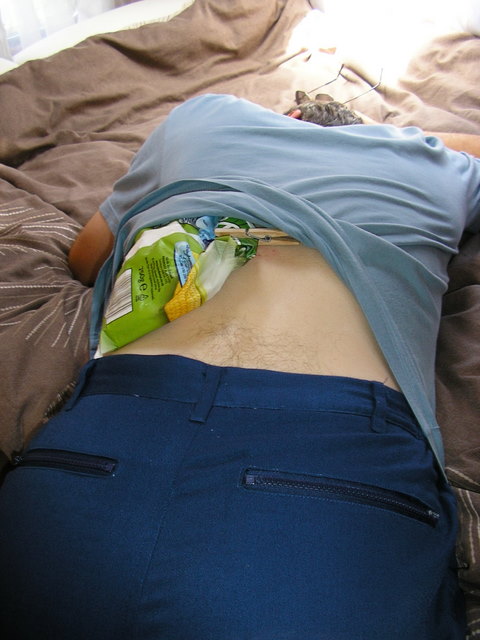
Back at the van I applied a pack of frozen sweetcorn (we didn’t have enough peas!) to the back and we had sweetcorn with the evening meal! The motorhome has a fixed bed and its height meant that I had to climb onto it and then crawl across it on all fours. Then came the problem of trying to lie down and whilst Jane was very sympathetic she couldn’t help laughing at my clumsy attempts and many curses. I then discovered how difficult it is to sleep with cracked ribs!
Photos: The White Hart stands next to the muddy-coloured canal in Talybont; The frozen sweetcorn in position – having got into this position, it was very difficult to get out of it!

Thursday, 1 July 2010

Thursday 24th June 2010 – Talybont on Usk


We packed up and set off for Brecon and some shopping. Buying good bread and meat has been difficult in the remote areas of Wales but Brecon has good shops with real bakers and butchers.
We arrived at Talybont on Usk and pitched again at Talybont Farm in time to watch Wimbledon. And I confess that we watched it all afternoon and evening, including the unbelievable 70 to 68 game win in the 5th set for Isner over Mahut. Almost as unbelievable was Murray's straight sets over Nieminen, without a single worrying moment, perhaps it was because he was playing in front of the Queen. We also watched that football match. Overall, a very good day for British sport.
Photos: The large main field of the Talybont Farm campsite.

Wednesday 23rd June 2010 - Aberbran


It has to be done if you are a walker and visiting the Brecon Beacons – conquering the highest peak in South Wales – Pen y Fan. I had originally planned to approach the peak from the south, starting the circular walk from the Neuadd Reservoirs. This is supposed to be the best option giving wonderful views from the ridges that it follows. However it is more demanding than the route from the Storey Arms and given Jane's dislike of steep hills and the forecast for a hot day, I decided to opt for the shorter walk as described in the Best Walks in Southern Wales book.
We had driven to the Storey Arms car park and were ready to go by just after 09:00. This is very unusual for us but we were determined to avoid walking up the peak in the heat of the day. It was very misty when we woke up but the sun has dispersed it all by the time that we started.
The walk took us a short way down the main road to the next car park. A note for motorhome owners – it is better to park in the Storey Arms car park as that is open and busy and would be difficult for anyone to break into the van without being noticed. The lower car park has excellent picnic facilities but is surrounded by trees and dark, ideal for thieves and there are lots of signs warning people not to leave valuables in their cars.
After crossing a stream, we started the long climb with the flat-topped Corn Du (The Black Horn) in the distance, passing a National Trust plaque that told us that in 1965 the Eagle Star Insurance Company gave 8,150 acres of the Brecon Beacons to the National Trust in order to ensure that they would be open for public access. Well done those leaders of Eagle Star! Frequent stops were taken – only to admire the views of course – before we arrived at the ridge to see wonderful views down the Taf Fechan valley and its four reservoirs – Upper and Lower Nueadd, Pentwyn and Pontsticill. It was strange to think that I was cycling in the valley just one week ago.
We walked below Corn Du and on to Pen y Fan, reaching its cairn at 886 metres. The views from hear were spectacular, north over the lower land, the River Usk and Brecon. Into the Brecons, paths hugged the ridges, all winding their way to Pen y Fan (Hill of the Top). We walked around the summit for some time looking at the views before we descended and crossed the col to Corn Du (873 metres). This path was being improved and consolidated by the National Trust using a pre-Roman technique. Flat stones are packed upright in a shallow ditch and the gaps filled by soil and small stones. The result is a very stable and hard-wearing surface that will last for many years but it is not the most comfortable surface to walk on. The work is necessary because the hundreds of thousands of people who walk the paths every year cause huge erosion problems and the new paths should prevent damage to the moorland. More views were admired from the top of Corn Du and I had to tell one young Welsh woman that she hadn't “made it!” - she thought that she had just reached the top of Pen y Fan rather than Corn Du. Still I was able to say that the last bit was easy and tell her about a better route down.
The next short part of the walk clearly demonstrated the effect of erosion. The path ran close to the edge of a ridge and the eroded path attracted run-off water that further deepened the trench. This made it very difficult to walk and, like many others, we walked to one side of the path, causing further damage. We arrived at the Tommy Jones Memorial marking the place in 1900 where the body of a five year old boy was found. Tommy became disorientated whilst walking to his grandfather's house and died of exposure after walking at least 3 km and climbing over 400 metres. His body was found some 29 days later and a monument was erected paid for by public subscription. We cut across the open moor until we came to the well-used path back to the Storey Arms.
We got back to the campsite in time to watch Wimbledon and view that amazing match that was halted due to bad light at 59 games all in the 5th set. An heroic performance by Mahut and Isner and it is not over yet.
Photos: Soldiers, complete with guns, leaving the Storey Arms car park perhaps on the 'Fan Dance' – the gruelling SAS training hike where they cross the Pen y Fan peak twice; Life on the Edge – at Corn Du; A view from Corn Du over the glacial pond of Cwm-llwch above which, on the ridge is the small Tommy Jones Memorial; To Be A Pilgrim – Jane with the flat top of Corn Du in the distance.

Tuesday 22nd June 2010 - Aberbran


Looking at the map, I discovered that this area is relatively flat – a cycling opportunity!
Jane wanted to have a quiet day so this fitted well with my plans. I had spotted a Roman Fort nearby and we had thought about walking to it but this was an obvious target for cycling.
On the way at Aberycir I deviated to take a look at the church, built on the site of an ancient Celtic church indicated by the tell-tale circular churchyard. It is a lovely plain church and was made more interesting by the church history provided for visitors. The visitors book was especially interesting with entries made by a number of Italian prisoners of war in 1942, apparently accompanied by members of the Women's Land Army (W.L.A) who also signed the book.
Behind the church is a Norman Motte and Bailey castle but I couldn't see it from the church and, as it is on private land, I wasn't able to visit it.
I cycled on over the River Ysgir and took an unmarked road down to Y Gaer Farm and the Y Gaer Roman Fort. This is actually on the opposite bank of the river from the Motte and Bailey castle but trees obscure the view between them. The Normans obviously considered the area to be important because of the previous Roman occupation and put up their own castle to stamp their authority. I asked directions from a group of walkers in the farmyard and they seemed quite knowledgeable. I asked if they knew whether there had been any recent excavations and they said that they were just about to start – they were archaeologists! It turned out that the site must be an important one as the defensive banks were very clear and there are extant stretches of Roman wall. Three of the four gates have been excavated, the fourth being under the farm buildings. I understood from the archaeologists that fields around the fort show signs of considerable occupation. I would love to know more about the site but CADW have not provided any information boards – I will have to check it on the Internet.
The timing was excellent – back to Henrietta for lunch and Wimbledon.
Photos: The church of St. Cynidr and St. Mary at Aberyscir; The visitors' book with the Italian POW signatures; One of the gates at Y Gaer Roman Fort showing the Roman road.

Monday 21st June 2010 - Aberbran


Back to Wales.
We reversed our journey of last Thursday as far as Brecon where we stopped to have a look at the town. The Welsh name of the town is Aberhonddu, named after the small river Honddu that together with the River Tarell joins the much larger River Usk here.
The very useful Town Guide provided by the Town Council allowed us to plot a route. We started by walking out from the centre and along the aptly named Castle Street, crossing the Honddu River in the shadow of the impressive castle ruins. Built within 25 years of the Norman Conquest the castle was never taken by force but it was partially demolished during the Civil War. A large Regency house was built in part of the castle and the grounds and this has now become the Castle of Brecon Hotel. Another part is Ely Tower, the residence of the Bishop.
We walked up hill to reach the Cathedral church of St. John the Evangelist, built in the 13th and 14th centuries on the site of and using some of the fabric of a Benedictine Priory church constructed in the late 11th century. The priory is thought to have been preceded by an early Celtic church. The church is very interesting and there is also a very attractive cathedral close that incorporates some of the earlier priory.
We continued down into the centre and along by the river admiring the views of the Brecon Beacons. Brecon is very pretty and the town centre is vibrant with many small shops. It must be a nice place to live and it is certainly worth a visit.
We drove west along the A40, turning off to the hamlet of Aberbran where there are three campsites within a few hundred metres – two farm sites at Aber-Bran Fawr Farm and Aberbran Fach Farm and the Aberbran Caravan Club Site. We chose Aberbran Fach because the facilities looked slightly better, although if you are happy not to have a shower block, the Caravan Club Site (members only) at £8 per night (half what we paid) is excellent value.
Photos: The beautifully decorated Norman font in Brecon Cathedral; The Cresset Stone – in Mediaeval times the holes were filled with oil or candles and lit to provide light in those many dark corners, especially useful when they were attending their first service of the day at 2am!; On town trails we are always looking out for those blue plaques but I have never seen one like this before – I am sure that it wasn't there when I was last in Brecon in 2020.

Sunday 20th June 2010 – Ross on Wye


The Sunday walk has to be a shorter one so that people have time to drive home. We walked from Ross to Hole in the Wall along the banks of the Wye. This time there were very professional looking young scullers rowing double sculls with great precision. We thought that there was going to be a race but didn't have time to wait and see.
The walk was really nice but Hole in the Wall was a disappointment – there were plenty of walls but we couldn't find any holes. The ladies were particularly disappointed because there was no cafĂ©. It was a centre for PGL Adventure Holidays and canoes were lined up on the banks ready for one of their activities.
We headed away from the river past fields of wheat and barley and back into Ross. A late lunch was taken at the Riverside pub before the group split up and headed home, except for us who headed for our motorhome.
Photos: Detritus on the morning after the match before – obviously one fan was upset about England's performance; There were huge fields of barley – just think how much beer this could produce!; The Wye near Hole in the Wall; Poppies and BAGS.